

Case study
Industrial site hazard proximity alert system
Translating a safety-critical concept into a viable technical system under real-world uncertainty
Engagement summary
The challenge
Early-stage safety-related product with implicit requirements, novel IP, and highly variable real-world RF behaviour.
Our approach
A lightweight, systems-led framework to surface assumptions, define architecture boundaries, and validate highest-risk technical unknowns early.
Outcomes
A working concept demonstrator delivered in 3 months, with key technology risks mitigated and a clear path to next-stage investment.
The challenge: safety-critical performance in an unpredictable environment
The engagement focused on developing and de-risking a safety-critical IoT concept to prevent workers entering hazardous proximity zones on construction and industrial sites.
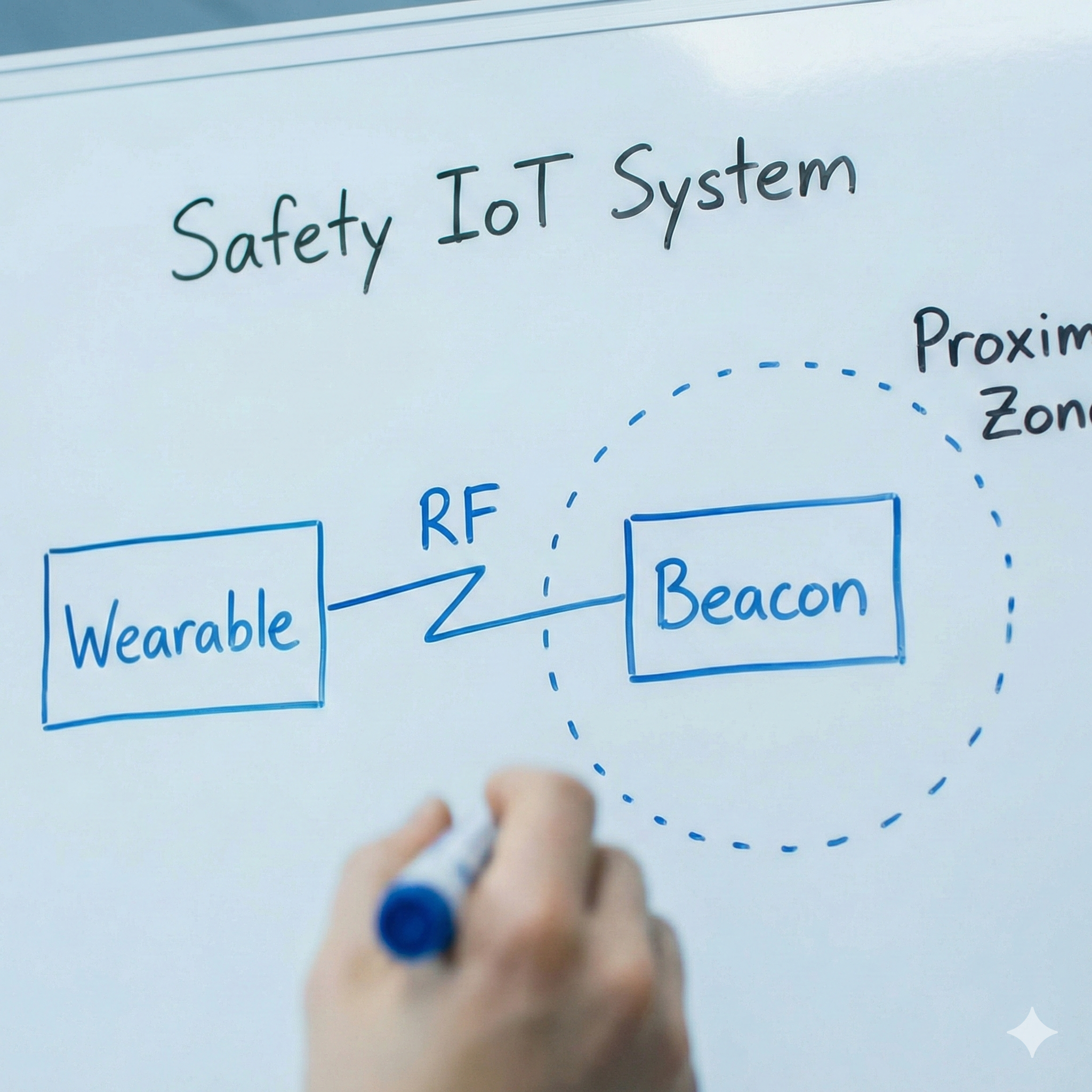
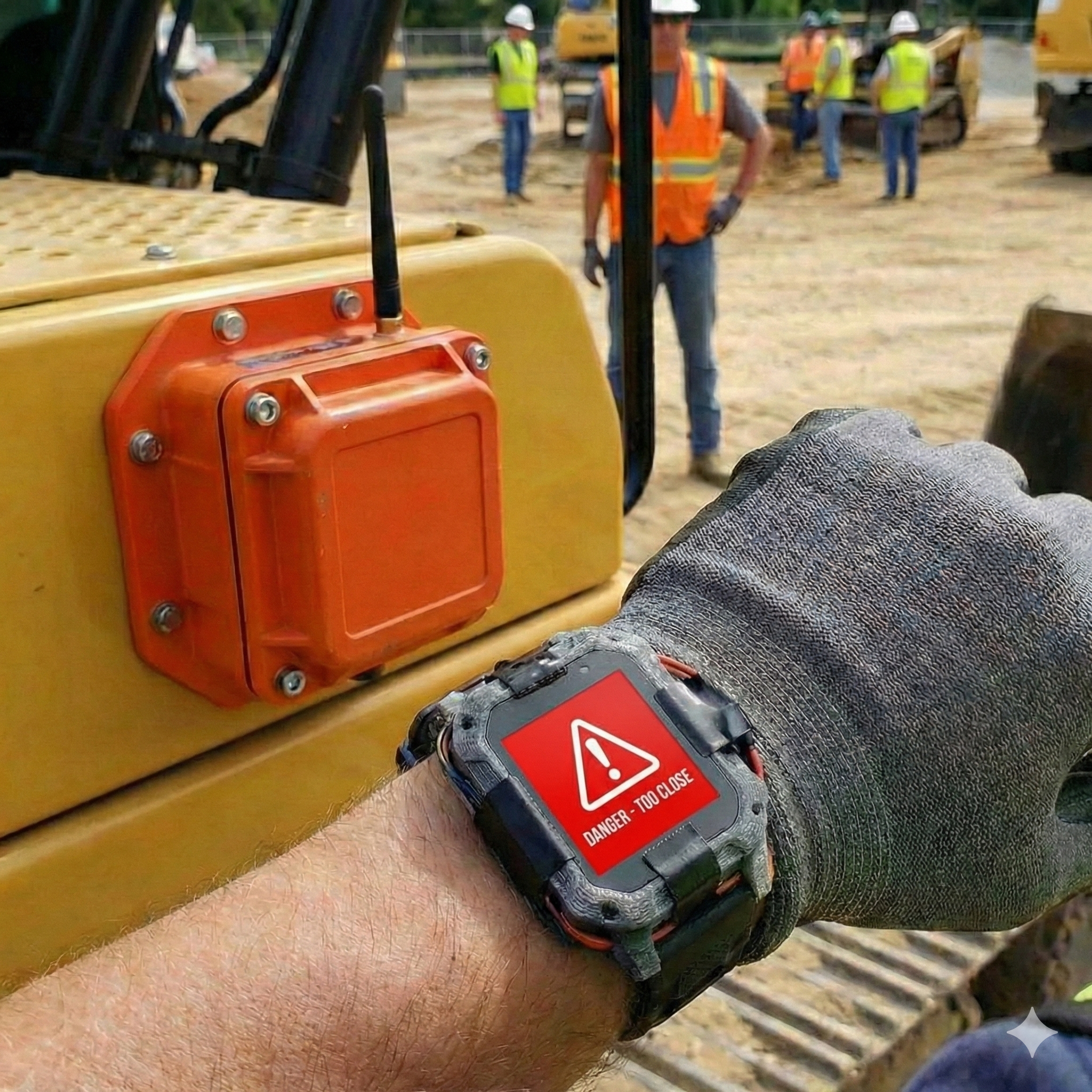
The product paired a wearable device with distributed beacons around hazardous equipment, triggering alerts when workers crossed unsafe boundaries. It needed to function reliably across highly variable, uncontrolled site conditions.
At project start, requirements were implicit and informal. A core technical uncertainty sat at the heart of the concept: whether RF signal behaviour could be used as a dependable proxy for distance in real operating environments. If this assumption failed, the safety intent of the product would collapse.
As an early-stage product, the objective was not completeness or compliance, but to rapidly test and reduce this fundamental risk before investing further.

The approach: focusing on the leverage points
Embedded day-to-day as Technical Lead with the engineering team, Navitect applied a pragmatic systems approach to translate the safety concept into a viable technical system and working demonstrator.
Problem structuring and requirements definition
Translated the founder’s brief into clear functional and performance requirements, explicitly capturing assumptions around detection accuracy, environmental variability, and alert behaviour.
System architecture and decomposition
Defined a clear system architecture spanning wearable hardware, distributed beacons, firmware, and supporting software, with explicit responsibilities and interfaces across disciplines.
Early risk and hazards analysis
Conducted an initial hazards analysis to identify safety-related risks and derive additional requirements, informing early design decisions while respecting IP constraints.
Leverage-point focused development
Identified RF variability and proximity-detection performance as the primary technical risks and structured the concept prototype specifically to validate these aspects early.
Iterative refinement and delivery coordination
Managed requirement changes pragmatically as new information emerged, coordinated execution across disciplines, and led regular client reviews through to the final demonstrator.
The outcome: reduced risk and informed next steps
Early, structured focus on the highest-risk uncertainties enabled rapid progress without premature optimisation.
Working concept prototype delivered in approximately three months
Critical technology risks identified and reduced early
Coherent system demonstrator used to support funding and next-stage decisions
Clear alignment between technical feasibility, safety intent, and business objectives
This engagement illustrates Navitect’s role in converting deep domain insight into focused, coordinated progress. By aligning teams around a small number of decisive leverage points, ambiguity is reduced early, non-essential work falls away, and development advances with clarity and momentum rather than late, costly correction.